
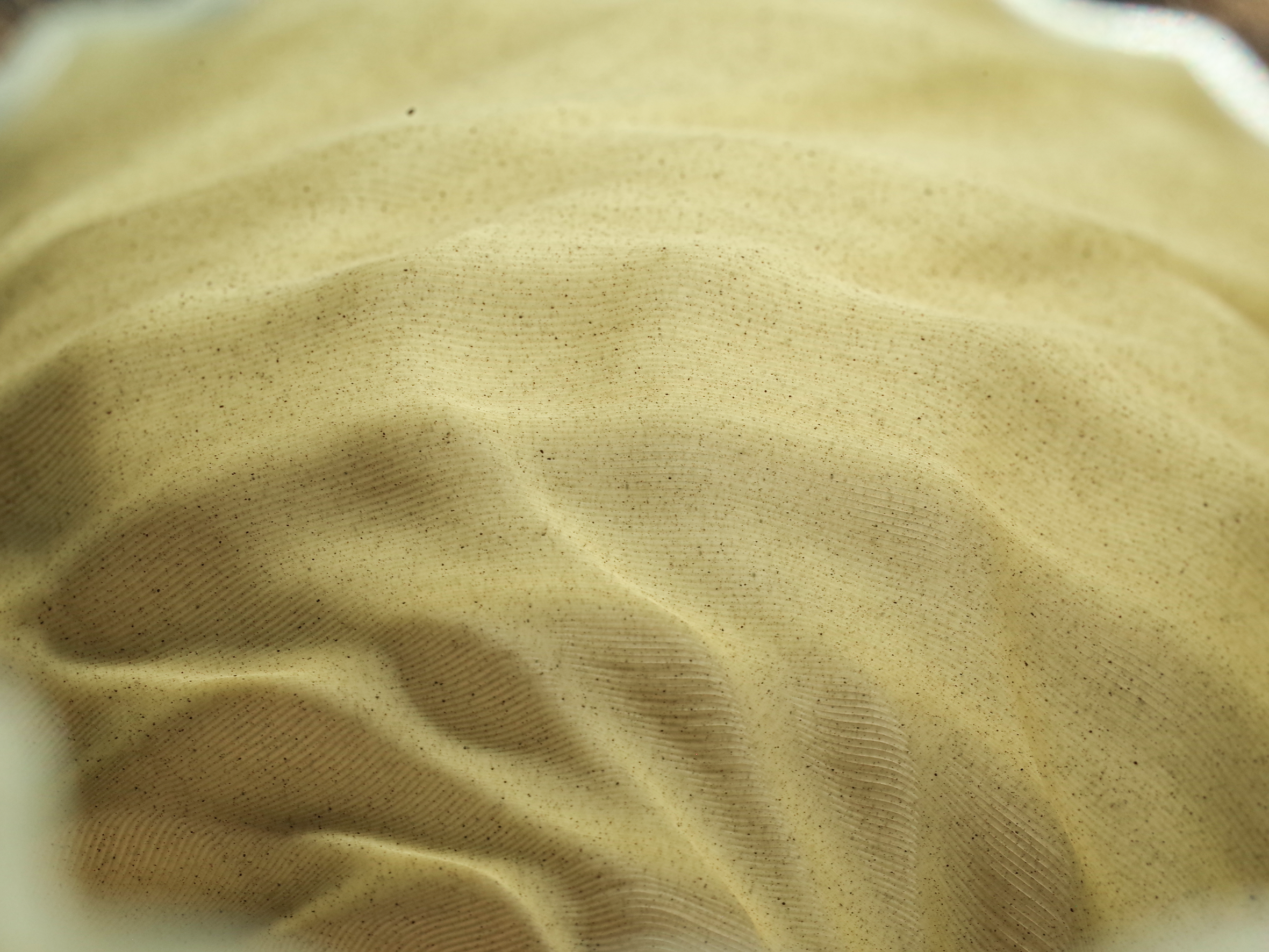
Everything leaves a trace
Make it a soft one
We believe materials should be designed with care, for the experience they create today, for the trace they leave tomorrow.
Through biomaterials and 3D printing, we shape objects and surfaces for the spaces around us.
TraceMatter™ PHA 3D Printing Filament is our starting point. Our PHA-based biocomposite blends are tested in our London studio. We work with brands, architects and designers on custom materials, prototypes and small-batch production.
TraceMatter™
PHA 3D Printing Filament

Most plastic is designed to last, then designed to be forgotten.
TraceMatter™ starts from a different question: what happens after the object has done its job.
At its core, TraceMatter returns to nature on its own. No factory required.
TraceMatter is our family of PHA-based biocomposite filaments for FDM 3D printing. Selected natural residues give each formulation its colour and tactile character.
In the studio, we test every blend ourselves. Composition. Print settings. Geometry. So we know exactly how a material behaves before it reaches your printer.
PHA stands for Polyhydroxyalkanoates, a natural reserve microorganisms store after feeding on plant sugars and oils, close to fat. It melts and shapes like any plastic, and at the end of its life, microorganisms break it back down again, in soil or seawater, into carbon dioxide, water and organic matter.
Most bioplastics, PLA included, only return to nature inside an industrial composting plant. TraceMatter works differently. Its core PHA resin is certified by TÜV Austria for both home composting and marine biodegradation.
For architects and brands, it means a sustainability claim that holds up under scrutiny, as procurement and planning rules keep tightening. For larger companies, it means one less material risk in the supply chain. For makers at home, it means a filament that finally lives up to being eco friendly.
Home compostable base resin

Marine biodegradable base resin
Bio based, not petroleum based
Blended with real biomass residue
BIOMASS COLOURS
Colour shaped by its source
We combine PHA with biomass residue to create filaments shaped by their source. Depending on the formulation, that source may appear through colour, translucency, visible particles, texture or scent.
TraceMatter™ has a naturally matte surface and a warm, soft-touch quality. It diffuses light gently, softening the appearance of FDM layer lines and giving printed forms a quieter, less synthetic character.
*New colours and biomass formulations are currently in development.
Shell White
A soft white filament blended with finely processed shell powder.
It has a clean, even appearance, a soft matte finish and a warm, tactile feel.


Seaweed Green
A muted green filament blended with seaweed residue.
It has a slight translucency, allowing fine seaweed particles to remain clearly visible throughout the printed form. These natural variations give the material greater depth and make each print subtly different.
A faint natural seaweed scent may be noticeable during printing or when the material is exposed to heat or water.


TRY NOW.
RESERVE THE FIRST RELEASE.
TraceMatter™ launches in full in late October 2026
Start with a small quantity to test colour, surface and printer response, or reserve a 750 g production spool before the full release. Reservations receive first-release pricing and secure access to the initial allocation.
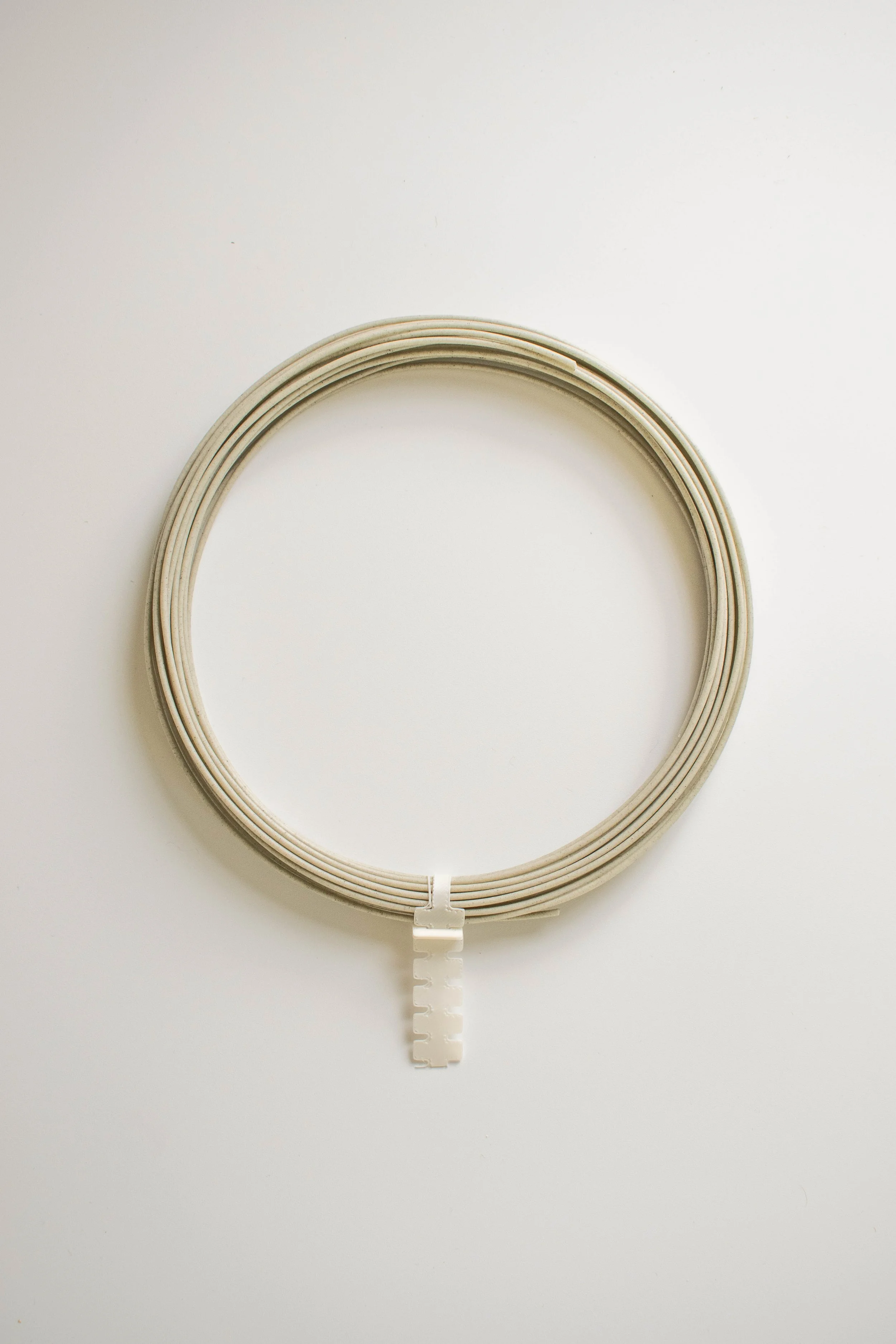
TraceMatter™ is SoftTrace Studio's PHA-based biocomposite filament for FDM 3D printing. Our first Biomass Colours are Shell White, made with finely processed shell powder, and Seaweed Green, made with seaweed residue.
These trial formats let you test colour, surface and printer response before ordering a full spool. Each 30g sample is supplied as a loose coil without a spool. Choose one colour, or try both with 30g of Shell White and 30g of Seaweed Green.
New to PHA? Visit our official printing guide for starting settings, a downloadable starter file with prepared print settings, and direct access to printing support. Check the file's printer and slicer compatibility before printing, and calibrate for your own machine and conditions.
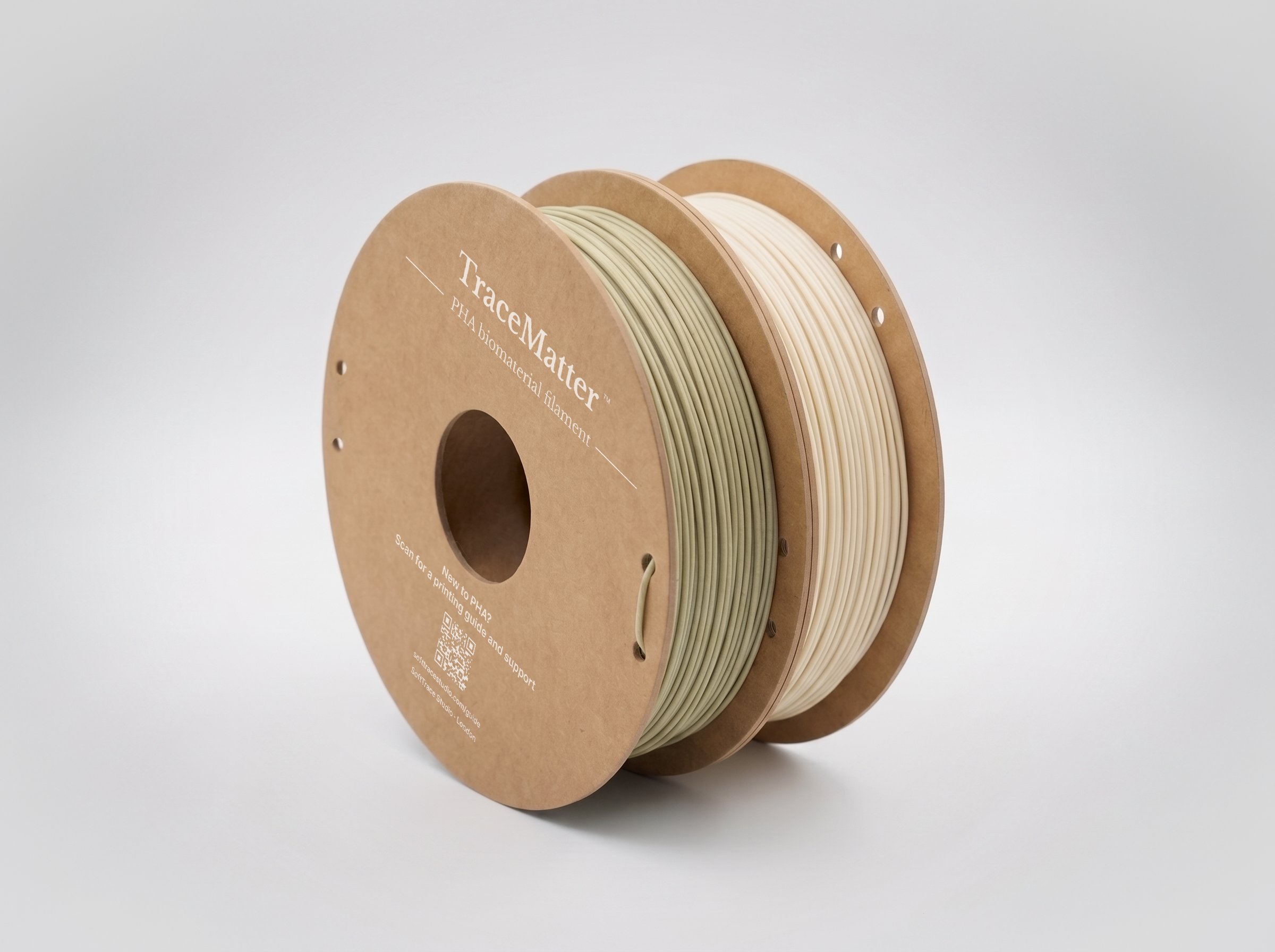
TraceMatter™ is SoftTrace Studio's PHA-based biocomposite filament for FDM 3D printing. This 750 g first-release spool is available in Shell White, made with finely processed shell powder, and Seaweed Green, made with seaweed residue.
Paid pre-order - £29.50 per 750 g spool. The standard single-spool price is £32.50.
Full release is planned for late October 2026. Expected UK dispatch: October 28. Expected delivery by October 31. If the schedule changes, we will contact you; you may cancel for a full refund before dispatch or agree a revised delivery date.
Free standard UK delivery on orders of 4 or more.
Ordering 10 or more? Contact us for studio/trade pricing before checkout.
New to PHA? Visit our official printing guide for starting settings, a downloadable starter file with prepared print settings, and direct access to printing support. Check the file's printer and slicer compatibility before printing, and calibrate for your own machine and conditions.
PERFORMANCE

>50%
Flexible Response
In injection-moulded tests, specimens stretched past 50% before breaking. Standard PLA typically snaps at under 10%. TraceMatter™ bends instead of shattering.
5–15 kJ/m²
Impact Resistance
In injection-moulded tests, the material resisted cracking under sudden impact - a level of toughness rarely seen in biodegradable materials.
85°C
Heat Resistance
The material holds its shape up to 85°C , well above normal indoor conditions, including direct sun through a window. Tested under load on injection-moulded specimens.
Soft Matte
Surface & Touch
A soft matte finish gently diffuses reflected light, making FDM layer lines less noticeable. The surface feels warm and lightly textured.
*Performance of FDM-printed parts will vary with print settings, wall geometry and orientation.
MATERIAL, PROCESS AND AFTERLIFE
Most materials are chosen for how they perform. Few are chosen for what happens after. TraceMatter™ starts with both questions at once.
Take the shell powder and seaweed residue we use. Published research on PHA composites shows that fillers like these - natural fibres, minerals and organic waste - speed up biodegradation. That is the category TraceMatter sits in. Conventional plastic behaves the opposite way, lingering in soil and water for decades.
Production follows the same logic. A mould locks a shape in early, before anyone has worked out what happens to the material next. 3D printing builds straight from a digital form instead, so small batch and on demand runs create far less offcut and excess stock, and one supplier carries the whole story from material to finished piece.
At the end of an object's life, that early thinking pays off. TraceMatter is built to be consumed and broken down by microorganisms, in soil or seawater.
This is the basis of our approach to sustainable design. We test every blend before it reaches you, because the trace we leave behind should be a soft one.
ONGOING SOIL EXPOSURE OBSERVATION
TraceMatter™ test pieces after five months in garden soil.
The surfaces show clear signs of degradation. The outer walls have eroded, exposing parts of the internal print walls. Both samples have become thinner, warped and less rigid.

MATERIAL IN PRACTICE
Through objects, surfaces and prototypes, we explore how the material behaves at different scales and in different settings. Each project helps refine the next formulation, structure or use.

Material Studies
FDM-printed tests developed to evaluate form, colour, scale and production potential.
Objects
3D-printed lighting, vessels, housings and tactile prototypes for everyday spaces and emerging hardware.

Surface
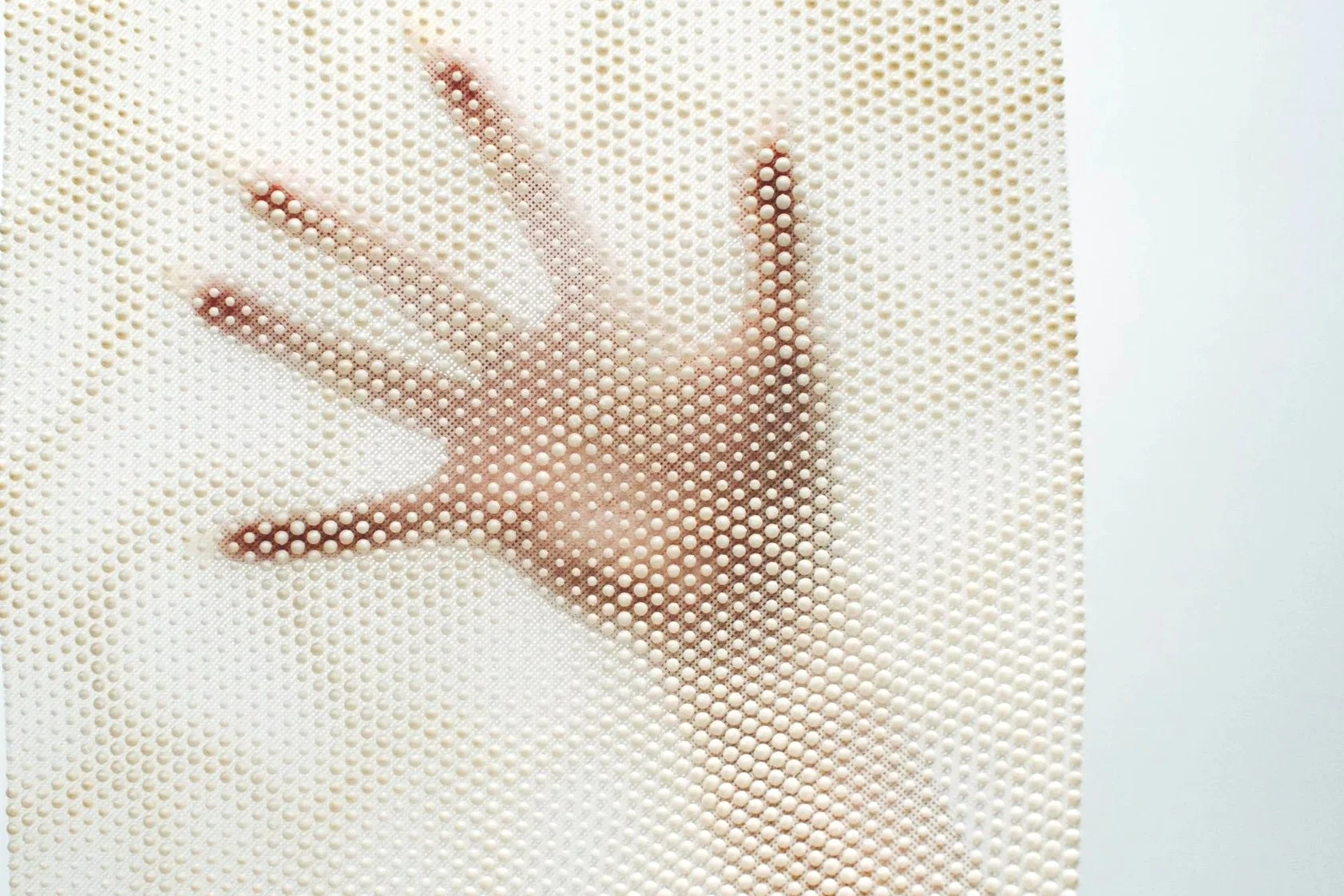
Material studies exploring structure, texture, light and architectural applications.

COLLABORATE
Projects can begin with a material, an idea or a production need. We offer custom filament development, creative collaboration, and 3D printing for prototypes and small production runs. Each service can stand alone or be combined around the needs of a project.
Product Development & Small-Batch 3D Printing
Develop housings, tactile surfaces, interaction prototypes and small-batch non-load-bearing parts for products and emerging hardware. Support can include design development, material selection, FDM production, hand-finishing and assembly.
Custom Filament Development
Custom colours and biomass-filled formulations developed around a project’s visual, tactile and printing requirements. Development begins with material samples and print trials.
Creative Collaboration
Explore new applications for TraceMatter™ across products, interiors, exhibitions and architectural projects.


ABOUT THE STUDIO
SoftTrace Studio is a London-based design and material practice exploring new possibilities for biomaterials through 3D printing.
At the centre of this work is TraceMatter™, our developing range of biocomposite 3D-printing filaments built around natural by-products. Each material is explored through objects and prototypes, revealing how it feels, performs and could be used in everyday products and spaces.
Founded by Shuting Lei, a Goldsmiths graduate with a background in spatial experience design and digital fabrication. SoftTrace Studio works with brands, architects and designers on custom materials, prototypes and small-batch production.

Get in Touch
Frequently Asked Questions
-
PHA is a family of polymers made through biological fermentation. Microorganisms use plant-derived sugars or oils and store PHA as an energy reserve. Under suitable biological conditions, microorganisms can metabolise PHA again.
-
The PHA 3D-printing material at the core of TraceMatter™ holds certification for home compostability and biodegradation in seawater, within defined test conditions and thickness limits. Ask us for the evidence scope if it matters to your project.
-
TraceMatter™ is our proprietary PHA-based biocomposite formulation. Selected colours use finely processed natural residues to create their visible and tactile character.
-
TraceMatter™ is supplied as 1.75 mm filament, with a net weight of 750 g and an approximate length of 240 m.
-
TraceMatter™ works with common FDM printers that take 1.75 mm filament.
Open-frame printers: Bambu Lab A1 mini, A1, A2L; Snapmaker U1; and similar machines.
Enclosed printers: Bambu Lab P1S, P2S, H2S, H2C, H2D, X1C and X2D. Keep the front door open for the whole print.
-
Start at 210°C and calibrate within a 205–230°C range for your printer, colour, geometry, batch and ambient conditions. A 0.4 mm nozzle or larger is recommended. These are starting settings, not guaranteed results across machines.
-
TraceMatter™ is soft and flexible. It can bend or jam in automatic feeding systems. Feed it directly from an external spool holder. Do not use AMS or any other automatic filament-changing system.
For multi-colour projects, we recommend the Snapmaker U1. It uses four separate toolheads, so the filament never passes through a shared changing mechanism.
What visitors noticed when they picked up our 3D-printed objects at Material Matters London, and the ideas they brought back to the studio.